

Step 1
Rig
Your crew throws a standard arborist line over the target limb, the same rigging process you use today.
Transforming vegetation management through precision & automation.
Learn more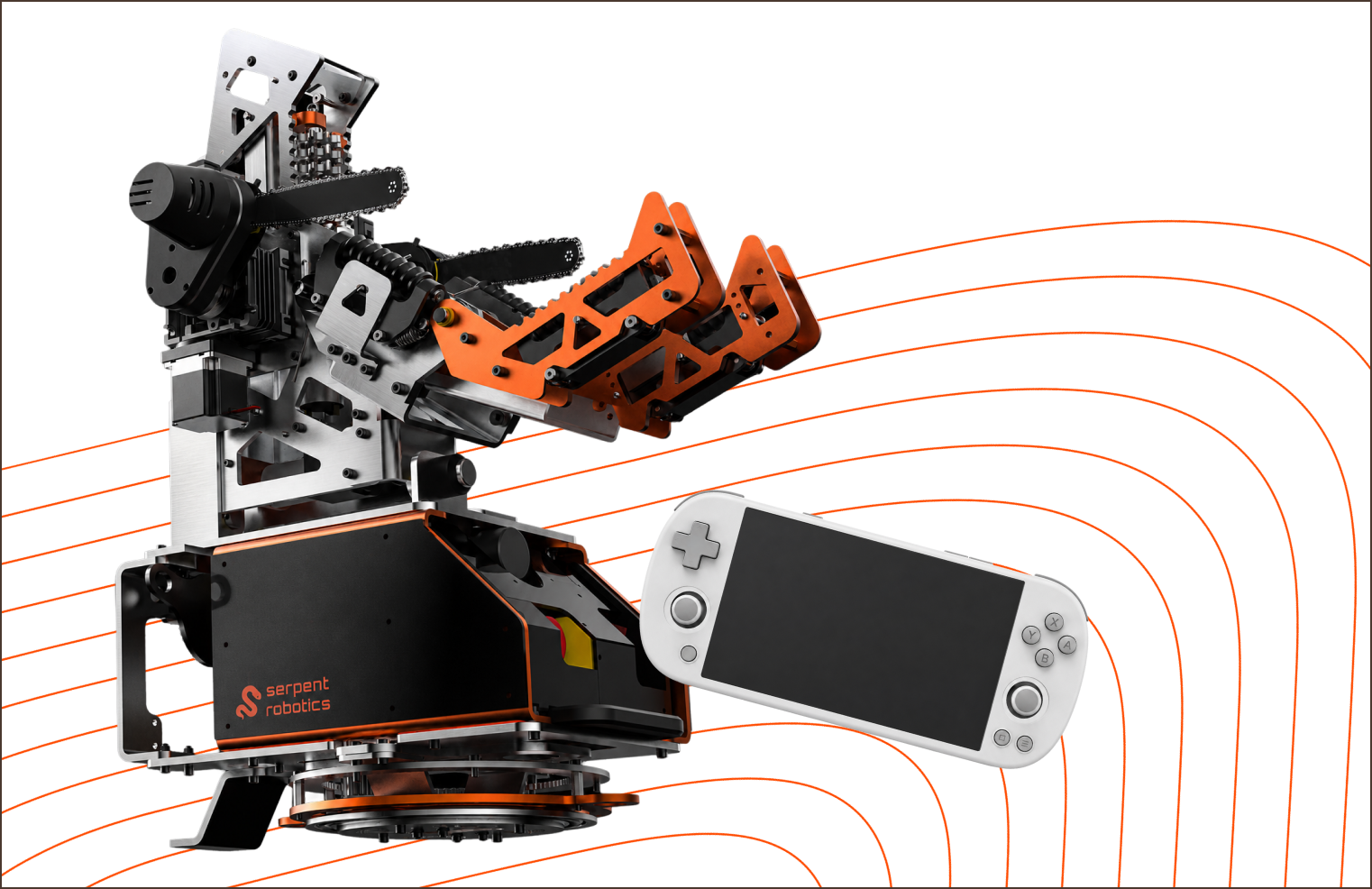
The first ground-controlled robot that cuts, holds, and lowers a branch, without a climber in the tree.
How It Works
Your crew throws a standard arborist line over the target limb, the same rigging process you use today.

Clip SR-01 onto the line from the ground and hand control to your ground operator via the controller, no climbing required.

Your arborist operates SR-01 from the ground via a controller, controlling movement, positioning, and every cut in real time.

Your operator brings SR-01 back down via the ground controller. Unclip, repack, and move to the next position or the next job.
Rig to Retrieval
From the Field
The crews who clear the lines, remove the hazards, and restore the canopy after the storm, they protect our communities and our environment. Serpent exists to protect them back: safer at height, lighter on the ground, ready for what the climate brings next.
Learn moreOne Robot, Seven Capabilities

The robot ascends through remote control using its ascender system, without requiring a worker to climb.

The robot securely attaches to a target before and during cutting. The clamp holds the target without slipping or losing stability.

The robot traverses along a target branch while maintaining grip, balance, and control.

Performance covers cut location, cut angle, saw control, feed rate, vibration management, and jam recovery.

The robot reaches and holds a useful working position near the target, rotating, aligning, and orienting itself at height.

The robot supports, holds, and lowers a target after it has been cut, preventing uncontrolled drops, swings, and secondary hazards.

The robot clearly communicates its state to the operator and crew, including camera views, operation status, battery level, and warnings.
Note: Serpent is built for removals, dismantling, storm/hazard work, and hard-access jobs, not fine ornamental pruning or matching a skilled climber's finesse inside a mature crown.
AI & Automation
Serpent is building toward automation that reads the tree, reads the cut, and handles the routine work with less effort from the operator. Grounded in real-world field data and industry expertise, this technology is under active development.

Serpent takes the routine cutting, so skilled climbers are freed for the complex, high-value work only they can do.

Fewer people per job means the same team completes more jobs in a week, directly answering the labor shortage, turnover, and aging workforce squeezing the industry.

Reach tight lots and corridors a crane or bucket truck can't, cutting the cost, transport, and setup time of the big machines you'd otherwise need.

Every hour on battery replaces gallons of diesel and its price swings, cutting fuel out of your per-job costs entirely. And with no combustion, no operator at the blade, and fewer on-site hazards, incident rates drop, the kind of safety record that bends insurance premiums lower year over year.
"You can't get a lift to every single tree. You can't get a bucket truck or a crane. It's just too expensive to bring all that stuff out."
"Urban forestry is hazardous work, and doing that work is constantly figuring out how to get the job done while mitigating hazards."
"...having buried two friends in this industry and many others nearly so, I know this is a device that is long overdue."
Frequently Asked Questions
Can't find the answer you're looking for? Send us an email.
No, and it's not trying to. Serpent handles the routine, dangerous cutting so your skilled climbers are freed for the complex, high-value work only they can do. Think of it as a tool that lets one operator do from the ground what used to require a climber in the tree, not a replacement for the craft. For fine, in-crown ornamental pruning, a skilled climber is still the right call. Serpent is built for removals, storm and hazard work, and hard-access jobs.
Reaching branches in complex canopy geometry is the hard problem in this space, and it's exactly what we've engineered Serpent to solve, not just vertical rope ascent, but positioning and moving through real canopy to reach the cut. We test against a matrix of branch angles, tapers, and diameters rather than clean demo trees. It won't reach every branch a climber can, and we're honest about that envelope, but the messy tree is the tree we build for.
Controlling the branch after the cut is Serpent's core capability, not an afterthought. It holds the cut section and lowers it under control, so limbs don't drop or swing into structures, the thing that turns a routine job into an expensive one. This is the part most tools don't do at all: they cut, but they don't manage where the wood goes.
Setup speed is a priority we design against directly, because we know a tool that's slow to deploy doesn't fit a real crew's day no matter how capable it is. The target is a deploy–operate–retrieve cycle that fits your existing workflow, run by a small crew without heavy support equipment. We'd rather tell you a real number on a demo than a marketing one here, setup time on your kind of job is exactly what a demo is for.
The value isn't one machine versus one worker, it's that fewer people are needed per site, so your crew completes more jobs, and your best climbers aren't burned out on routine removals. Add lower equipment needs on tight lots a crane can't reach, no fuel, and a safety profile that can ease insurance costs over time. We're still finalizing pricing and rental options with early partners, and we'd rather build the ROI case around your actual jobs than hand you a generic number.
Serpent is operated from the ground with a handheld controller, familiar, game-controller style, and a live camera feed. The interface shows you the state that matters: clamp status, saw status, load, battery, signal, and specific warnings ("saw binding, line nearby") rather than a vague "unsafe." The goal is that at any moment you can answer one question fast: is it safe to move, clamp, cut, carry, or stop?
Serpent is an early-stage system in active field testing, built by a team that's shaped it around real arborist research and field input. We'd rather show you what it does on a real tree than overclaim on a website, which is why the demo is the honest way to see where we are. We're building in the open, and we'll be straight with you about what's proven versus what's still being validated.